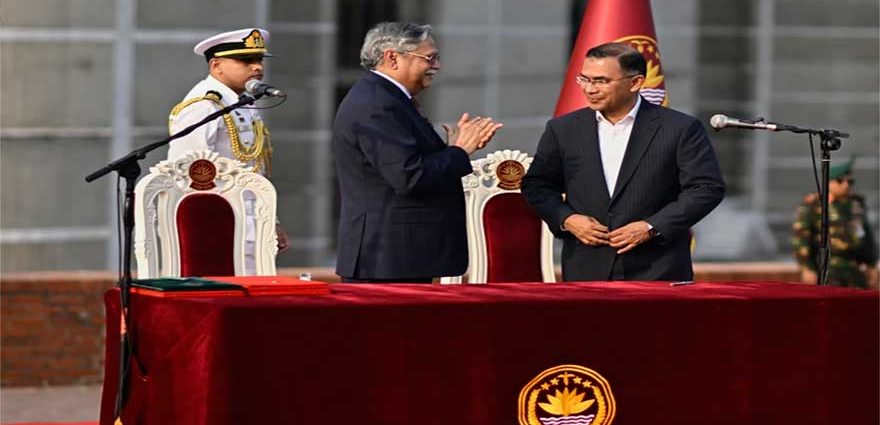
The Bangladesh Nationalist Party and its partners gained 212 seats in the 350-member Parliament, whereas an 11-party alliance led by the Jamaat-e-Islami party.
DHAKA, Bangladesh (AP) — Bangladesh’s new prime minister was sworn in on Tuesday following his party’s landslide victory in parliamentary elections last week, the country’s first since the massive 2024 uprising, and a vote billed as critical to the nation’s future political landscape after years of intense rivalry and disputed polls.
Prime Minister Tarique Rahman, who will serve for five years, is the son of former Prime Minister Khaleda Zia and former President Ziaur Rahman. He is Bangladesh’s first male prime minister in 35 years. Since 1991, when Bangladesh returned to democracy, either Rahman’s mother or her archrival Sheikh Hasina has served as prime minister.
President Mohammed Shahabuddin, the country’s figurehead, administered Rahman’s oath of office. On Tuesday, dozens of Cabinet and new government members were sworn in.
The Bangladesh Nationalist Party and its allies gained 212 seats in the 350-member Parliament, while an 11-party coalition led by the Jamaat-e-Islami, the country’s largest Islamist party, got 77 seats to form the opposition.
The student leaders that spearheaded the 2024 rebellion founded a new party, the National Citizen Party (NCP), as part of the 11-party coalition led by Jamaat-e-Islami. The NCP won six seats.
In Bangladesh, voters elect 300 members of parliament directly, with the remaining 50 seats designated for women and apportioned proportionally among the winning parties.
Rahman, 60, who returned to the nation in December after 17 years in self-exile in London and soon before his mother died, has committed to strive for democracy in Bangladesh, which has a population of 170 million.
The election was overseen by an interim administration led by Nobel Peace Prize laureate Muhammad Yunus, who took control after Hasina’s ouster. The voting was generally calm and rated acceptable by foreign observers.
Foreign dignitaries and diplomats attended the event on Tuesday. The attendees included Maldives President Mohamed Muizzu, Bhutanese Prime Minister Tshering Tobgay, an Indian delegation, and leaders from Nepal, Sri Lanka, and other nations.
Earlier on Tuesday morning, A.N.M. Nasir Uddin, the head of the electoral commission, administered the oath of office to all newly elected parliamentarians separately.
However, BNP MPs declined to take a second oath as members of a planned Constitutional Reform Council, as required by a referendum held alongside Thursday’s balloting. The interim administration stated that the “Yes” side won the vote, and it reached an agreement with a series of reform measures to modify the constitution while maintaining all elected parliamentarians as members.
In response to the revolt, key parties, including the BNP, signed a national charter, which sparked the referendum. The second oath was taken by lawmakers elected from the Jamaat-e-Islami and its supporters, underlining the new Parliament’s complexity.
The referendum refers to political changes like as term limits for prime ministers, stricter checks on executive authority, and other measures to avoid legislative power accumulation. However, detractors claim that growing Islamists are pushing hard for its adoption, and that the vote may change the nature of Bangladesh’s mostly secular constitution.
Rahman’s biggest adversary, the Bangladesh Awami League party led by Hasina, who was overthrown in the 2024 popular revolt, was barred from running. The Yunus-led administration also prohibited any operations by Hasina’s party, which had dominated the country for 15 years.
From her exile in India, where she has resided since August 5, 2024, Hasina condemned the vote as unjust to her party, which remains a strong political power. At home, Hasina was condemned to death on allegations of crimes against humanity for the hundreds of fatalities caused by the revolt.
She disputed the allegations and referred to the court as a “kangaroo court.”
Related posts:
 According to new Bangladesh textbooks, Ziaur Rahman, rather than Mujib, declared independence.
Jimmy Lai, a Democrat from Hong Kong, concludes his testimony at the national security trial.
China will not attend the G20 summit in Indian-occupied Kashmir.
NATO struggles covertly to choose a new commander
The new EU sanctions list for Hamas funders includes front businesses situated in Spain and Sudan.
Biden is isolated at home while Pelosi, Obama, and other Democrats urge him to reevaluate his 2024 candidacy.
Former Indian Prime Minister Manmohan Singh passes away at age 92.
Israel and Hamas have agreed to a cease-fire and hostage transfer, Qatar has announced.
Trump is sworn in as the 47th president of the United States.
According to new Bangladesh textbooks, Ziaur Rahman, rather than Mujib, declared independence.
Jimmy Lai, a Democrat from Hong Kong, concludes his testimony at the national security trial.
China will not attend the G20 summit in Indian-occupied Kashmir.
NATO struggles covertly to choose a new commander
The new EU sanctions list for Hamas funders includes front businesses situated in Spain and Sudan.
Biden is isolated at home while Pelosi, Obama, and other Democrats urge him to reevaluate his 2024 candidacy.
Former Indian Prime Minister Manmohan Singh passes away at age 92.
Israel and Hamas have agreed to a cease-fire and hostage transfer, Qatar has announced.
Trump is sworn in as the 47th president of the United States.
 Trump says that “help is on its way” and exhorts Iranians to continue their protests.
 US puts additional sanctions on Iran over the crackdown on demonstrators.
 Tensions in the region might rise as a result of India’s water politics: US journal